This Old Table

Antique Baker’s Table

This old table is an antique baker’s table.  I imagine it once stood in a farmhouse kitchen where the lady of the house used it exactly as intended as the center of her baking activities.  I found it several years ago at an antique show, and since my kitchen at the time lacked a center island,  I purchased it to serve that purpose.

Now it stands in the center of my kitchen where it gets constant use as a way-station for things that are coming or going.  Its where I unpack groceries to put away, deposit foods removed from the refrigerator, place hot foods just removed from the oven, pack up Mr. D’s lunch ready for him to carry off to work, etc.   But I am also proud to say that I use it also for its intended purpose as the center for my baking.

I love and particularly treasure things that are old, and I have a number of antiques.  Especially dear to me are the items that have been in my family for 2-3 generations, because I can associate them with the people who used them. Like my cast-iron frying pans and bean pot that belonged to my paternal grandmother.  When I use them I think of her home fries and her baked beans.  Likewise when I roll out pastry or cookie dough I use a wooden rolling pin that was once used by my maternal grandmother and I remember her wonderful breads and pastries.

Let me take you on a tour of my baking table/baking center. The table is made from cherry wood except for the top.  I don’t know what the wood of the top is, but it has had a lot of use and it shows.  It was, after all, a work surface.  Viewed from the front (see photo above) you will see two drawers with handles.  The upper one is quite shallow, and in it I keep a roll of parchment paper, cookie cutters, tubes of food coloring, muffin cups, bench knife, pizza cutter, anything small related to baking that will fit.

Side view showing large storage bins for dry goods.

The lower drawer is very large, deep and rounded, with a division in the center that creates two bins.  It was meant to hold flour and sugar in large quantities.
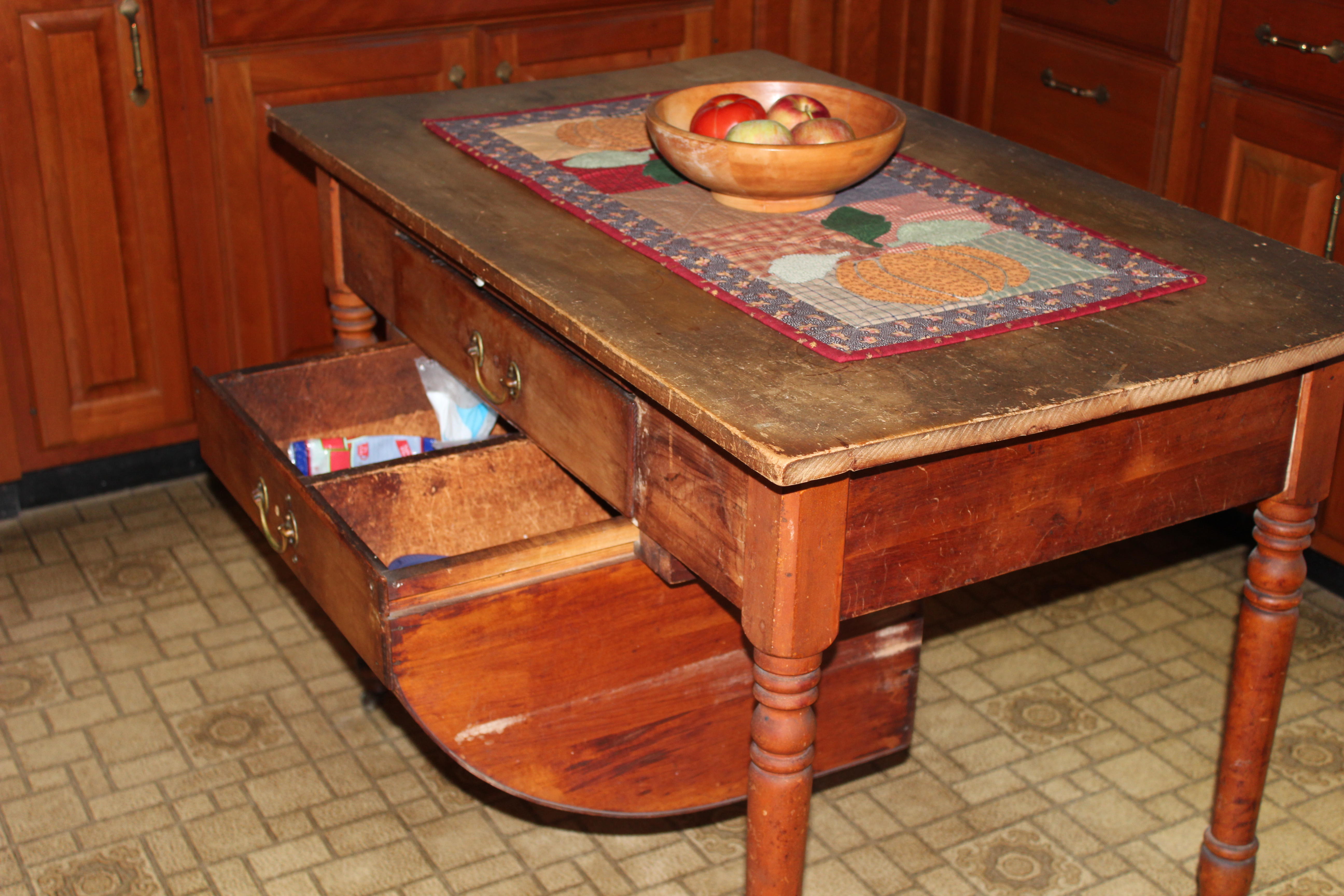
Lower drawer open to show the divider in the center creating two bins

As these ingredients were needed, the baker scooped out the required amounts.  I use those bins for storage of bags of specialty flours, brown sugar, confectionery sugar, chocolate and other kinds of chips; and also larger baking tools like my rolling pin, sifter, nut grinder, grater, etc.
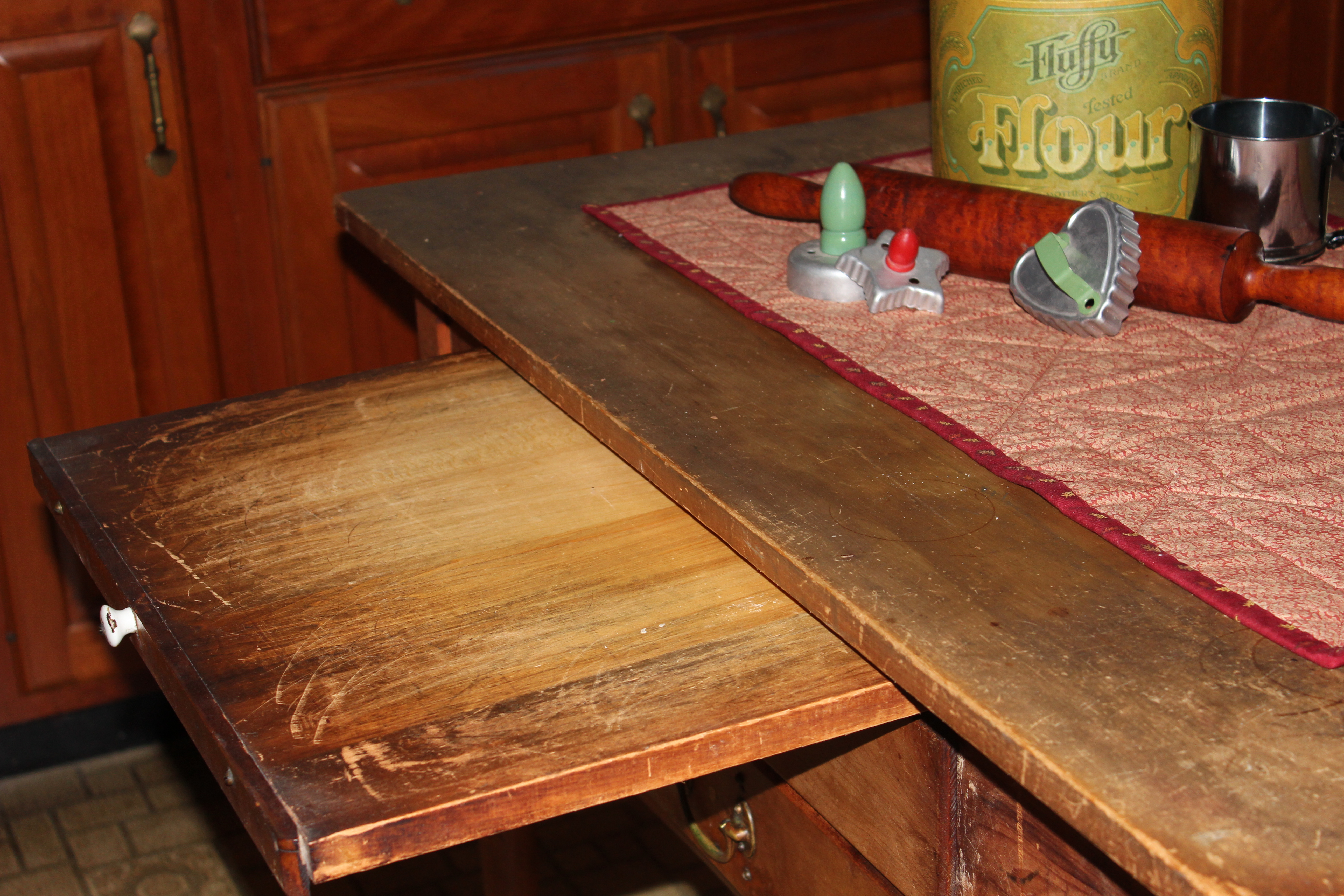
Removable pastry board.

Centered above the two drawers is a pull-out pastry board  (note small white knob) that comes completely out of the table and can be placed on top for kneading, rolling, and cutting dough.  I use this board a lot for all my pie making, cookie cutting, shaping of dough, just about anything where I need a large surface.  It is as smooth as satin from all the use it has had;  that’s why I love it.

Antique rolling pin, canister, cookie cutters and sifter.

In this final picture you can see my beloved rolling pin.  It was carved from one piece of wood, I think it’s maple, and it, too, is very smooth;  the wood grain of it is beautiful.  Along with it is pictured one of two old canisters I own and some vintage cookie cutters that belonged to my mother.    I love these old things and when I use them I feel a connection to the people who used them before me.

It has been my pleasure to give you a look into my kitchen, which holds so many things that are special to me.  I hope you have enjoyed it.

Emphasis on Squash

Fall arrives at my local farm market.
Courtesy, Gotta’s Farm

I wasn’t ready for it but now that its here I’ve adjusted to the new season. Suddenly I want to eat foods that represent Fall like apples, pears, ginger cookies, hermits, any thing with caramel, squash, pumpkin —–oh my, so many foods, so little time to get my fill before the farmer’s markets close for another year.

I think I’ve had just about enough zucchini and yellow squash.  I’m craving the bright color and flavors of winter squash.  It’s called winter squash but that’s not true, really.  It was planted in the spring like all the other vegetables, it’s being picked now, we just eat it mostly in the winter.  There are quite a few squash that are put into this category such as the butternut, acorns, Hubbards, spaghetti, and delicatas.  Winter squashes are fully grown–picked in September and October—with thick skins that keep them fresh and edible  well into winter months.

The long time they spend on the vine does more than give them a hard shell; it also gives the flesh time to develop the sugars and deep warm color that is its signature.  Winter squash are packed with so many vitamins and nutrients that it isn’t just delicious and comforting—it’s so good for you.  Extremely versatile, we can cook it into soups, add it into pastas, include it in a salad, or simply roast it with a bit of oil, salt and herbs.  The only real challenge is removing that thick skin, a task made easier by a sharp peeler or paring knife.  Some squash can be baked in their shells and the flesh scooped out, thereby sidestepping the peeling part.

I expect I’ll be sharing a variety of recipes with you that make use of squash, since we really like it and eat it frequently.  By way of introduction, I thought I would describe for you some of the many winter squash, that are now available in the farmer’s markets and grocery stores.  Perhaps you will be adventurous and try one that you have not had before.

Acorn Squash
Courtesy Gotta’s Farm

ACORN:  Found in most supermarkets, acorn squash is one of the most popular squash varieties.  It is small, acorn-shaped, and can range in color from dark green to yellow and white.  Its surface is ribbed, making it difficult to peel, so the best way to prepare it is to cut in half or quarters and  top with butter, brown sugar or maple syrup, and bake.  Its flesh turns sweet, tender and nutty and can be easily scooped from the shell.  I like to fill the indentation with sliced apples or raisins, then top with brown sugar and butter and roast until tender.

Buttercup Squash
Courtesy Gotta’s Farm

BUTTERCUP:  At a quick look you might mistake this squash for an acorn because of its deep green color, but instead of ribs it has white striped markings.  It is more round with a top that looks like a little hat.  It makes me think of a turban.  It too, has a very hard outer shell and is best cut in half or wedges, seeded, then roasted.  Its flesh is bright orange, much like an acorn squash, and can be prepared in the same way.

Butternut Squash
Courtesy, Gotta’s Farm

BUTTERNUT:  This squash is readily available in the supermarket from early fall through winter.  It is easily identified by its tan, smooth skin, and elongated bell shape. The true name for this squash is the Waltham Butternut, named for the Massachusetts city where it was first grown.  It is perhaps the best known and most widely used squash because it an be prepared in a variety of ways.  The flesh is smooth, fine and sweet, making it excellent for purees, though it is also good cubed and steamed or roasted.  Butternut squash is a good substitute for pumpkin in pie-making, and one of my favorite ways to use it is in Butternut Bisque, a delicious autumn soup.

Delicata Squash
Courtesy, Gotta’s Farm

DELICATA:  True to its name this petite, pale yellow squash has a delicate thin skin that becomes very tender when cooked.  The flesh is creamy, with a sweet, corn-like flavor.  It can be roasted and used in pastas or salads, or sautee slices in butter or olive oil until brown and caramelized.

Hubbard Squash
Courtesy, Gotta’s Farm

HUBBARD:  These are big, blue-gray, and bumpy.  They are the giants of the squash world, growing to be hugh with very thick skins.  Because of their size, they are hard to handle and manage.  If stored at cool temperatures, this is a squash that can be kept for up to six months. You may see them in the supermarket already cut into smaller pieces and packaged to be sold by weight. Home cooks who break one down, or purchase one pre-cut, will find the flesh sweet and tender when cooked.  Cut it into small pieces and boil, roast or steam it. It’s sweet taste makes it perfect for soups and pies.

SPAGHETTI:  Large and golden in color, the spaghetti squash is best known for its stringy, texture, which, when cooked presents a unique surprise.  After cooking the flesh separates and the strands resemble spaghetti pasta.  It can be prepared in a variety of ways including boiling, baking or microwaving. Once the flesh is tender, use a fork to “rake” out the strands all the way to the skin and serve it in the same way as pasta with seasonings, sauces, meats, or other vegetables. When selecting one for flavor and ripeness, look for a large spaghetti squash with deep yellow color.

Spaghetti Squash
Courtesy, Gotta’s Farm

This is for the Birds!

I see some unusual birds in our backyard from time to time.  Probably because we have a brook running through the property .  The birds follow the brook looking for small fish, and insects.  One day I saw a Great Blue Heron and he had an encounter with a squirrel.  The squirrel was startled by the hugh bird, ran quickly up the nearest tree and from a safe distance above the bird’s head, scolded and scolded.  I watched that scenario from inside the house laughing all the while.  Another day I had a flock of five wild turkeys, one Tom and four hens and he was so funny  to watch, strutting his stuff, opening his fan-tail and putting on a show for the ladies.

I like to let my flower garden go to seed because the seeds provide food for the birds, but we also put up bird feeders and suet blocks to encourage the birds and provide food and energy as they fly south for the winter.  Some winter birds remain, like cardinals and jays, so we have activity in our yard all year long

.  Some of those birds are ravenous feeders so keeping the feeders full can be an expensive commitment.  That’s why I like to make my own suet, so this blog post could be retitled Home Cooking for your Backyard Birds because the recipes it contains are for suet.

Suet technically refers to animal fat renderings, which most store-bought products contain.  But the term has been expanded to mean anything with a fatty or doughy base that you put out for  your feathered friends.

Courtesy of "Birds and Blooms"

Courtesy of “Birds and Blooms”

RECIPE FOR SUET #1

  • 1 cup cornmeal
  • 1 cup sugar
  • 1/2 cup flour
  • 3/4 cup water
  • 1 cup peanut butter
  • 1 cup lard (available from the butcher)
  • 1 cup raisins

In a medium bowl, mix the dry ingredients.  Then add the water and mix.  Put peanut butter and lard in a small bowl and microwave for 2 minutes.  Add to the cornmeal mixture along with the raisins.  Refrigerate for at least 2 hours.   This is good to spread in/on pinecones and hang from a tree limb.  Or you can freeze it, then cut into blocks to put in a suet feeder.

An employee at Wild Birds Unlimited store gave out the following recipe to customers encouraging them to make their own bird food to be most beneficial to the birds.  The best foods are heavy on the fat and lower in sugar and grains.  Here’s the recipe she gave out:

RECIPE FOR SUET  #2

  • 2 cups shelled, unsalted peanuts
  • 1/2 cup raisins
  • 2-3 tablespoons cornmeal

Process peanuts in a food processor until they’re the consistency of peanut butter.
Then add the raisins and process for another minute.  Add the cornmeal and process again.  Press this mixture into a mold of your choice.   This recipe will have the greatest nutritional value for your feathered friends.

SOURCE:  Birds and Blooms Magazine

Meat Marinades and Rubs

If you really want to spice up your barbecue  you could put on a limbo competition or dance the salsa, but a more conventional way is to use a meat marinade or spice rub.  Many backyard chefs are relying on these mixtures to tenderize and give an infusion of flavor to meats.

There are a multitude of premade marinades and rubs on the market from the classic to the exotic; each one promising to add an  explosion of flavor to an otherwise ho-hum piece of meat.  In my exploration of these products I have found that many of them contain a variety of additives that I’m not keen about eating such as high fructose corn syrup, modified food starch, xanthan gum (whatever that is) and potassium sorbate as a preservative. No thanks, I’ll make my own.

Marinades consist of acids, oils, and aromatics or flavorings.  It’s that simple. But when you have  the wrong proportion of acid to oil you can turn a beautiful steak into a gray, tough, flavorless, expensive embarrassment.  Acids such as vinegars, wines, fruit juices, yogurt, buttermilk, and even fresh ginger break down the collagen on the surface of meats and can denature the proteins, thus damaging the protein’s structure.  Meats,  i.e. proteins,  especially delicate ones like fish and chicken, left in a marinade too long can be totally ruined.  The proteins break down to the point where they lose moisture and structure and become dry and mushy.

So what does it take to make a good marinade?    The general rule is to use a light touch with strong acids such as vinegar or lemon juice, using no more than one part acid to four parts oil.  It’s the oil that carries the flavor anyway.

A tougher cut of meat can tolerate a longer marinating time using this proportion of acid to oil.  A tender cut of meat may not need any acid at all; just a little oil and some aromatics for flavoring.  In fact recent studies concluded that marinades do not tenderize meat as once thought.

So even though marinades aren’t used for tenderizing, they do help to add flavor and moisture.  However for most meats the marinade will generally only soak in about 1/8″ to 1/4″ deep.  The acids soften the exterior of the meat, allowing the oil to penetrate.  The denser the meat, with more connective tissue, the less the marinade will penetrate, so these meats can take a longer marinating time.  Meats in a marinade with oil and very little acid can remain overnight in the refrigerator.  A sure sign that red meat has marinated too long in a too-acidic marinade is a gray exterior.  For chicken or pork the exterior will turn white.

Another way to infuse BBQ with flavor is with dry rubs, a combination of spices, herbs, salt and sugar that creates a flavorful crust, something marinades do not.  A rub is not really rubbed into the meat but rather patted on rather heavily.  When a rub is applied, the browning of the proteins and sugars in the meat create a toasted, roasted, grilled flavor.  The sugar in the rub also creates caramelization.  Larger cuts of meat and especially slow-roasted meats can tolerate being left marinating with a dry rub over night in the refrigerator.  Tender cuts such as steaks, kabobs, and chicken breasts will like a light sprinkling of dry rub before grilling to provide a quick flavor boost.

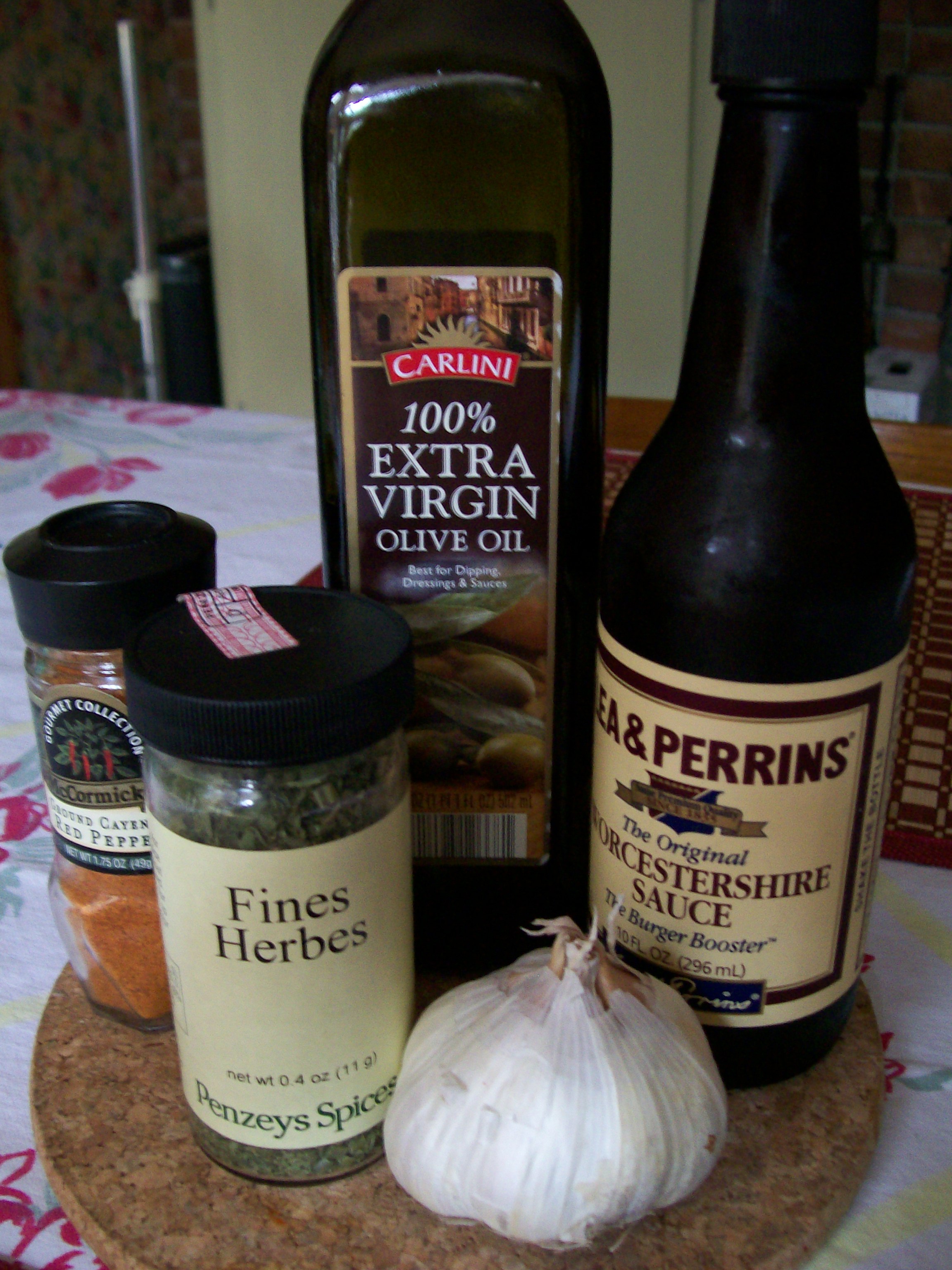
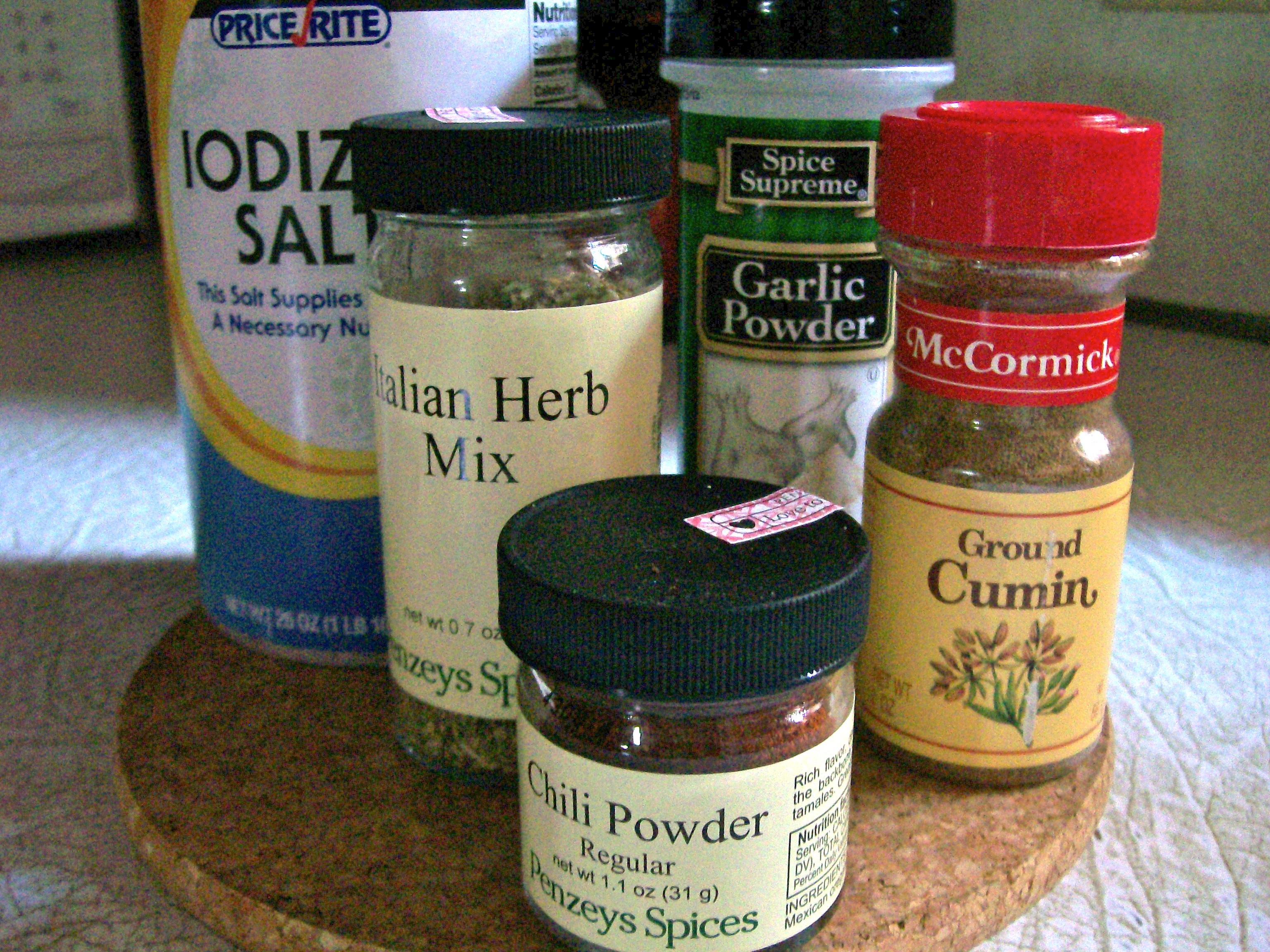
The combinations of seasonings in a rub can be  tailored to your own particular taste preferences, or to a specific ethnic cuisine.  Mix up the herbs and spices representative of Cajun, Indian, Greek, Italian or Mexican cuisine, and add some brown sugar and salt to the mix.  Start with a few proven rub recipes, then add or subtract ingredients until you get the mix you like.  Now you’ve created your own….    In tomorrow’s post I will be presenting a pork recipe that features a rub that I put together.  Stay tuned!

Hopefully  this post has not been too technical,  but has perhaps answered some questions for you or cleared up some misunderstandings.  Periodically I would like to include posts such as this one seeking to take an in depth look at specific products or methods of food preparation.  Having spent quite a few years of my professional life as a teacher, I frequently say, “once a teacher, always a teacher”, but I do not want to come across too strongly in that regard.   From time to time, I would like to present a post like this as I continue to seek the niche that will satisfy more readers.  However, If this is not the type of post you would like to read, please let me know.  Thanks so much for your comments and input.

Happy Grilling and Barbecuing , and Happy rest of summer!

Baking Powder and Baking Soda

I thought it was time for another entry in my Kitchen Basics series of articles.  This one came to mind as I was working to adapt an old recipe to today’s style of baking and ingredients.  It is about chemical leavening agents.

As you may know, I have quite a collection of old cookbooks acquired over the years and through hand-me-downs.  There are lots of neat recipes that catch my attention, but one thing that I have noticed is that the amounts of baking powder and baking soda are sometimes out of whack.  So here is some basic information about these two ingredients;  what they are, why they’re in a recipe, and how much is appropriate.  Knowing this information helps in recognizing if a recipe needs adjusting, or if you’re creating a recipe of your own.

BAKING SODA

Sodium Bicarbonate, the chemical name for baking soda, is an alkaline substance used in batters that have acidic ingredients such as buttermilk, molasses and sour cream.  When the baking soda is mixed with the acidic ingredient, there is an immediate release of carbon dioxide gas. Batters and doughs that only use baking soda as a leavening agent should be baked immediately.  Otherwise the baked product might not rise as high and the texture won’t be as light.  It creates a crisp texture in cookies, a crumbly one in quick breads.  Used to excess it adds a salty, bitter, unpleasant taste, and can give a brownish or yellow color to baked goods.

The recommended amount to use is 1/2 teaspoon of baking soda for the first cup of flour in a recipe, and 1/4 teaspoon more for each additional cup after that.  Always check the recipe to be sure there is an acidic ingredient to react with it.  ( buttermilk; sour cream, pumpkin, molasses, cocoa, brown sugar)

BAKING POWDER

This is a mixture of baking soda and tartaric acid in a buffer such as cornstarch.  It too, causes baked goods to rise and have a light texture.  Before baking powder, items like biscuits and cakes were made using yeast or a yeast-based sponge.  Double-acting baking powder is the most readily available type found on grocery shelves today.  “Double-acting” means it produces carbon dioxide in two stages;  when it is mixed with liquid and then again from the heat of the oven.  This increases the reliability of recipes, since getting a batter into the oven within a short time frame becomes less important.  Baking powder can lose its ability to leaven, so discard any baking powder that is past the expiration date on the can.

How much to use?   A general rule is 1 teaspoon of baking powder for each cup of flour in the recipe.  If there are a lot of add-ins such as chocolate chips, nuts, dried fruits, then increase baking powder to 1 1/2 teaspoons per cup of flour.

You are probably aware that most recipes tell you to mix either one or both of these products with the flour, stirring with a whisk to evenly distribute them throughout the batter,  thereby avoiding unpleasant little “lumps” that didn’t get mixed in well.

I hope this little tutorial was helpful in becoming more familiar with these two ingredients, and their use. I always feel that if  you understand what  the various ingredients are there for, then you are better equipped to make adjustments to a recipe.  Good luck, and Happy Baking!

A Taste of Tuscany

Although our extended family got together to celebrate Father’s Day, I wanted to treat my husband to a special meal, one which I did not have a hand in preparing. So I presented him with a list of three restaurants from which to choose.  I had heard or read good reviews of all of them, so I was pretty sure we would enjoy our meal at any one of them.  The one he chose probably would not have been MY first choice,  but now I’m so very glad it was his first choice, because it was delightful in every way.

Called Brio Tuscan Grille, it is located at the Mall.  (See why it was not my first choice?)  On a busy Sunday afternoon, when there were families out and about at the Mall, cars and traffic nearby,  this little place was an oasis of calm and quiet tucked to one side away from all the hustle and bustle.  We were seated outside at an umbrella shaded table, on a patio/courtyard, and there we relaxed, sipped a glass of wine, and leisurely ordered and then enjoyed a wonderful meal.

The menu is extensive, and there were some additional chef’s specials for Father’s Day.   Also, every Sunday a pre-fixe menu of four different offerings is presented.   This is what got our attention, because for 19.99 a three course meal was available that included a soup or Caesar salad, the main entree and dessert.  Our waiter, a friendly and well informed young man,  was very familiar with the menu and able to answer questions, and make suggestions.  As soon as we placed our orders, he brought us a basket of wonderful crunchy bread, and our first course(s) arrived soon afterward.

My husband’s first course was Lobster Bisque, and mine was the Caesar salad.  We were both very satisfied with our choices.  His soup was served in a small tureen, a beautiful golden color with bits of lobster floating in the rich cream broth.  My salad was cold and crisp romaine lettuce and crunchy croutons with a well balanced dressing and topped with shaved Parmesan cheese.  Even though I brought my camera with me with the intention of taking pictures and writing about this outing,  I completely forgot to start at the beginning and get photos of the appetizers.  I must have been really hungry!

Mr. D’s entree was called Chicken Limon.  It consisted of two large chicken  breast fillets, dipped in an egg batter, then pan cooked in a lemon sauce with capers.  It was served with a mixture of grilled vegetables, and spaghetini, a fine pasta similar to angel hair.  It was attractively plated and garnished with sliced lemons.  The quantity was such that he was not able to finish all of it, and brought some home for enjoying at a later time.

My entree was called Shrimp Verduta.  It was served in a large, shallow dish, and consisted of a mixture of large shrimp, spinach, sun-dried tomatoes, artichokes, and caramelized onions over a bed of angel hair pasta.  This was absolutely delicious.  The smell and taste of garlic was there, but not overpowering, and the blend of flavors seemed perfect to me.  I enjoyed it thoroughly, but could not eat all of it, so I too brought a portion home.

We were very happy to have saved room for the desserts.  Our waiter brought to our table a sample display of six different desserts from which to choose.  They were all served in small glasses–not a large serving–but just enough to satisfy after a large meal.  Mr.D. chose the chocolate cake with caramel sauce and cream topping, (below, right); and mine was hazelnut pudding topped with sliced almonds,  whipped cream and a drizzle of chocolate sauce.  Oh, my!  it tasted like Nutella, and I was in heaven.  This is what they looked  like before we devoured them!

            Would we go back here again?   Absolutely!

Homemade Ricotta Cheese

“Little Miss Muffet sat on a tuffet, eating her curds and whey”.  Ever wonder what that nursery rhyme was all about?  Well there’s no better way to explain than through the making of Ricotta Cheese.

Whipping up a batch of fresh ricotta cheese gets you bragging rights and a delicious product that is free of additives,etc.  Try some with a few Italian herbs and a little olive oil mixed in and served on bruschetta.  Sit back and enjoy the compliments.  You deserve them!

Before I get to the 1-2-3’s, let me talk a little bit about the process.  Because we are making cheese, we need milk.   It is best to use whole milk as it will give you a nice, rich ricotta that is smooth and creamy; not grainy like some commercial products can be.  From a half-gallon of milk, you will get about two cups of cheese.

Milk is made up of mostly water, with milk fat and some proteins.  The major proteins are of two types:  curds and whey.  Proteins are long strands of amino acids which when exposed to heat or acid, bond to each other producing curds.  The remaining liquid which is left behind is the whey.  Milk can “curdle” naturally as it ages and the bacteria in it multiply causing the milk to sour.  But the cheese we are making is achieved by causing the curdling intentionally by heating the milk and adding an acid.

Have the following supplies ready before you begin:

  • 1/2 gallon of milk
  • 3 tablespoons white vinegar
  • 1/2 teaspoon salt
  • a cooking thermometer
  • a colander lined with 5-6 layers of cheesecloth
  • a heavy-bottom saucepan

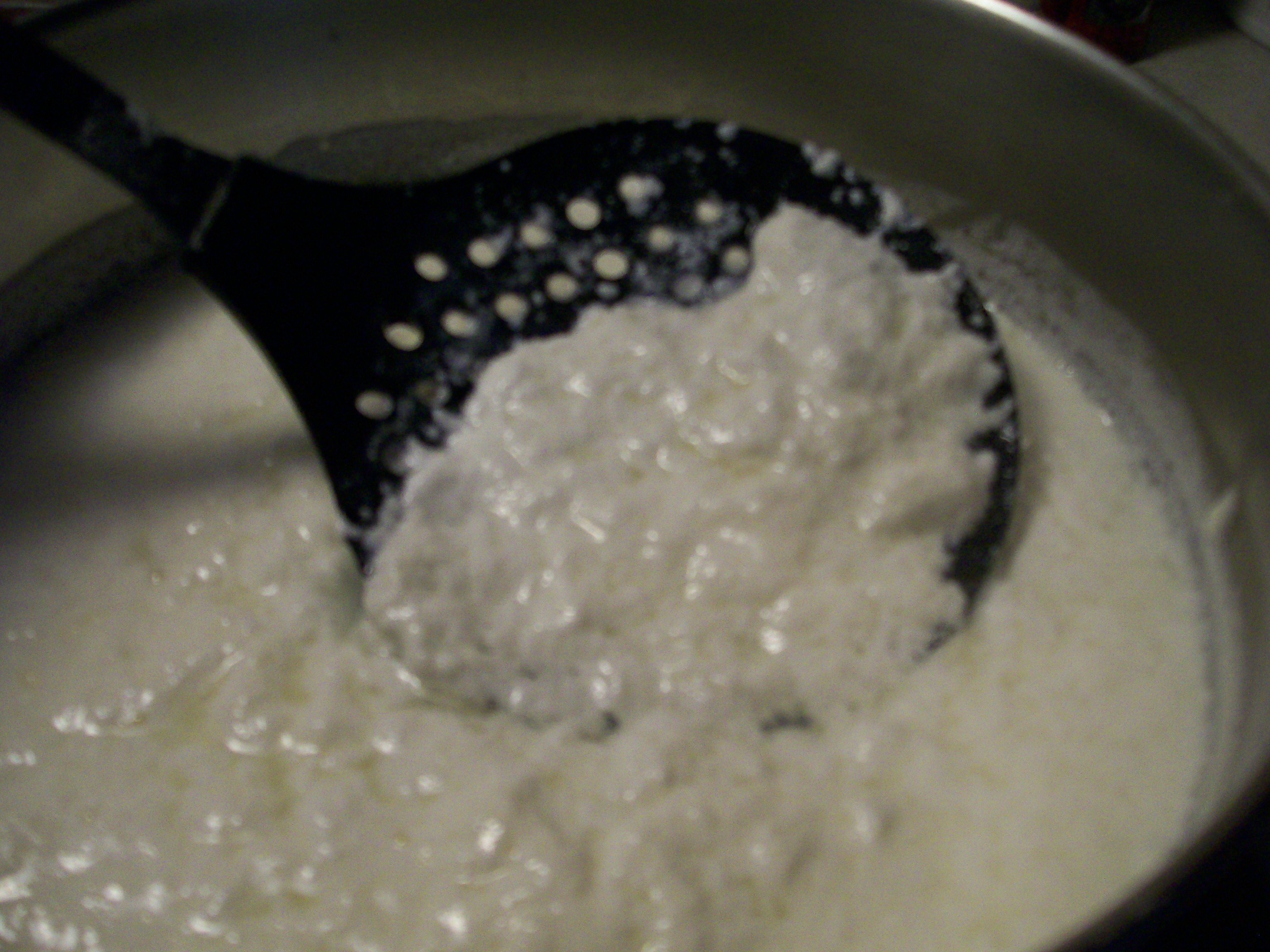
Combine the milk, vinegar and salt in the saucepan and heat to 185 degrees.  Stir frequently to prevent it from scorching.  As it heats, you will see the curd proteins clumping together.  Once it comes to temperature, take it off the heat, and let it sit for about 10 minutes to make sure it curdles completely.

Place the lined colander over a bowl to collect the whey. ( It can be used in place of milk in anything that uses milk i.e., pancakes, muffins, etc.)  Pour or ladle the curds into the cheesecloth and let it drain from 5-30 minutes.  A shorter drainage time will give a creamier cheese; a longer time will produce a drier more coarse cheese.  Pick up the bundle and gently squeeze out remaining whey.

Use the cheese warm on bruschetta or pasta, or place in an airtight container and refrigerate it.  It will keep for several days.

I used most of mine to make Stuffed Shells with Marinara Sauce, and I will be posting the recipe for that soon.  I’m sure I will be making the ricotta cheese again as I would like to try it in a cheesecake.  Oh, my thoughts just went spinning off imagining it served with  fresh strawberries.  Yum, Yum!  I’ll keep you posted.

The Life of a Computer

It seems to me that there are a lot of similarities between life itself and computers.  Life happens, as the saying goes;  meaning that things do not always go smoothly.  Unexpected occurances happen…..sometimes for the good, but often times not so good.  And so we must adjust our plans, our moods, even our way of life, sometimes.  Likewise computers can throw you a curve, just when it is most inconvenient.

The computer that I use to write this blog has a few years on it, and is used jointly by me and my husband.  Last weekend it CRASHED, sending us both into a panic.  After much agonizing over what to do, Mr. D., being the guru that he is, was able to get it running again, but we feel that it is probably temporary.  So I will be shopping for a new computer….just for me….where I can carry on with my blogging.

I will continue to post new blogs as long as this baby keeps running, but there may be some days with no new posts, as I get a new one up and running.  So I ask for your patience and understanding, while I try to smooth out the bumps in the road. 

If you have experienced any kind of similar situation,  I would love to hear about how you coped.  Thanks, Carolyn

Pizza Dough

With this easy and delicious recipe, pizza will quickly become an often-served meal in your home.  If you prefer, you can replace the whole wheat flour with regular bread flour.  I depend on my bread machine to make my yeast doughs, but of course you can make it in the traditional mix and knead method if you prefer.

  • 1 1/3 cups water
  • 1 1/2 tablespoons olive oil
  • 3/4 teaspoons salt
  • 2 teaspoons dried oregano, optional
  • 1 teaspoon pizza dough flavoring, from King Arthur Flour
  • 2 cups white whole wheat flour
  • 2 cups bread flour
  • 2 teaspoons yeast

1.  Place ingredients in pan of dough machine in the order recommended by your machine. 

2.  Set for DOUGH cycle, and press START.

3.  At end of cycle, remove dough from the machine and roll into 1 or 2 pizza pan-sized circles.  Place on lightly oiled pizza pan and turn any excess dough under itself to form a high crust.  Cover and let rise for about 30 minutes. 

4.  Spread with desired sauce and toppings.  Place in preheated 400 degree oven and bake for 25-30 minutes.

5.  Alternately, you may divide the dough into 2 balls, wrap in plastic wrap and foil, and freeze for later use.


Source:  Slightly adapted from The Big Book of Bread Machine Recipes